
SECTION SEWN · SMYTH SEWN · THREAD SEWN
Thread sewn binding
Held by thread through every fold, not by glue alone. Softcover or hardcover, from about 64 pages, in runs from 50 copies.
How a thread sewn book is built
Sheets are folded into signatures — sections of 8, 16, 24 or 32 pages. Each signature is stitched through its own fold, then sewn to its neighbours. Only afterwards is the block glued into a softcover or cased into boards.
Nothing is cut off at the spine. The paper is still continuous at the fold, and the thread passes through it. That single fact is what separates this binding from every glued one.
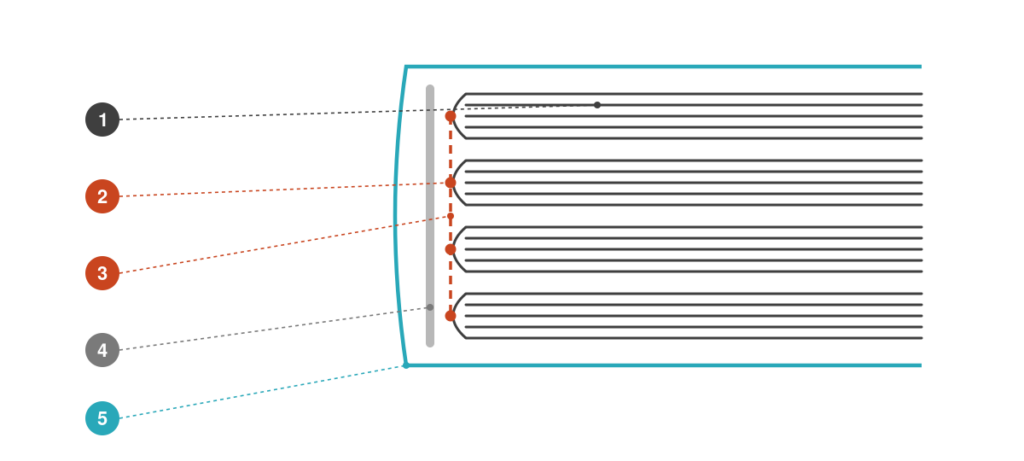
1 Folded signature — a printed sheet folded down to 8, 16, 24 or 32 pages. Sixteen is the usual working unit.
2 Thread through the fold — each signature is stitched along its own spine fold, so every leaf in it is caught by thread.
3 Signatures sewn to each other — a second run of thread links section to section down the length of the spine.
4 Mull — an open-weave gauze glued across the spine. On a hardcover its wings are what actually hold the boards to the block.
5 Hollow back — on a hardcover, a paper tube sits between the block spine and the case spine. The book opens without dragging on the covering material, which is why it lies flat and why the spine does not crack.
What sewing actually buys you
It opens flat and stays open
Where the block spine is not glued directly to the case spine, the book stays open on its own. For a cookbook on a worktop or a score on a stand, that is the whole point — and it is a property of the construction, not something that can be added later.
It survives being used
A glued spine fails when the glue fails. A sewn one has to break thread, leaf by leaf. This is why reference books, atlases and library editions have been built this way for two centuries.
It handles paper that glue struggles with
Heavy and coated stock springs back out of a glued spine. Thread does not care about the surface of the paper — it goes through it.
The spine can be rounded
Sewing adds bulk at the fold. Rounding and backing spreads it, giving the familiar convex spine and shoulders for the boards to sit against — and a book that keeps its shape on a shelf for decades.
Head and tail bands — an option, not a default
The small woven band you see at the top and bottom of a hardcover spine is the head band and the tail band. Centuries ago it was structural: sewn into the ends of the block, it took the strain when someone pulled the book off a shelf by the spine.
On a modern book it is glued on and decorative. It closes the small gap between the block and the case at head and tail, and it is one of the few places where a second colour can appear without touching the cover design at all.
It exists only on cased books. A softcover has nowhere to put one.
And it has to be asked for. It is inexpensive, but it is not automatic — if you say nothing, your book will not have one. Specify the colour, and whether you want a plain band or a two-colour stripe. Most people choose it against the endpapers rather than against the cover, because that is the pairing the reader actually sees when the book is open.
When it is not the right answer
- Below roughly 64 pages there is little to sew. Saddle stitching is cheaper and better.
- Short-life print — a seasonal catalogue or a programme read once does not need to outlive the season.
- Tight budgets on long runs — sewing is an extra operation and it is charged as one.
- The fastest possible schedule — sewing, and drying afterwards, add days.
Tell us what the book is for and how long it has to last, and we will say which binding we would choose and why.
Thread sewn or perfect bound?
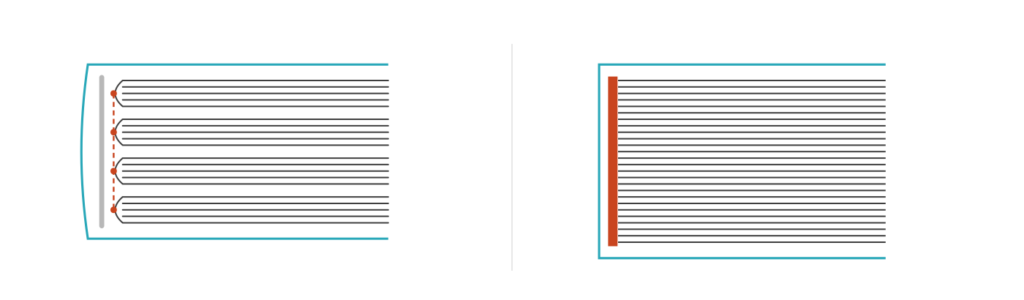
The same book block, held together two different ways. This is the decision most people are actually making — and it changes cost, durability and how the book opens.
| Thread sewn | Perfect bound | |
|---|---|---|
| Held by | Thread through every fold | Glue on a milled spine |
| Opens | Flat, without being pressed | Well with PUR, less so with hotmelt |
| Lasts | Decades of repeated use | Years of normal use |
| Extent | From about 64 pages upwards | From about 32 pages to a 50 mm spine |
| Coated and heavy paper | No difficulty | Needs PUR |
| Costs | More — an extra operation | Less — fewer operations |
| Suits | Reference, art, cookbooks, children’s books | Novels, catalogues, manuals, reports |
If your book is a novel, a manual or a catalogue with a defined life, read the other side of this comparison: perfect binding and PUR.
Selected productions
Four sewn jobs, with the binding line taken from the real specification.

Raging Justice
Thread sewn, black board endpapers, extra folded section. A collector’s edition built to be kept.

Cooking hardcover
Sewn and glued, straight spine, 140 gsm woodfree endpapers. A book that lives open on a worktop.

Taschen Garten
Sewn and glued, with a yellow reading ribbon. An annual used right through the season.

Evolution book
Sewn hardcover with a full-colour interior, so the spreads lie flat where the images cross the gutter.
More in recent productions. Or go to the service page you need: book printing · photo and art books · children’s books · catalogue printing.
Cost, schedule and a quote
Sewing adds an operation, so it adds cost and a few days. On a hardcover the difference is smaller than people expect, because casing-in dominates the price anyway. On a thin softcover it is proportionally larger.
We do not publish a price list, because every specification is quoted as a whole. Send us format, extent, paper and quantity — or just describe the book — and you will have a detailed quotation, usually within one business day.
Not sure what to specify? The book specification guide walks through format, paper and binding, and the file preparation guide covers bleed, colour and export.