
PERFECT BINDING · PUR · SOFTCOVER
Perfect binding
The spine is milled, the pages are held by glue, the cover is drawn on in one piece. From about 32 pages up to a 50 mm spine — and with PUR, far stronger than its reputation.
How a perfect bound book is built
The printed sheets are folded and gathered, then the folds are milled off at the spine. Every page becomes a separate leaf standing on a layer of glue. The cover is drawn on in one piece and creased at both spine folds.
Fewer operations than sewing means lower cost and a shorter schedule. What holds the book together is the glue — so which glue is the most consequential decision on this page.
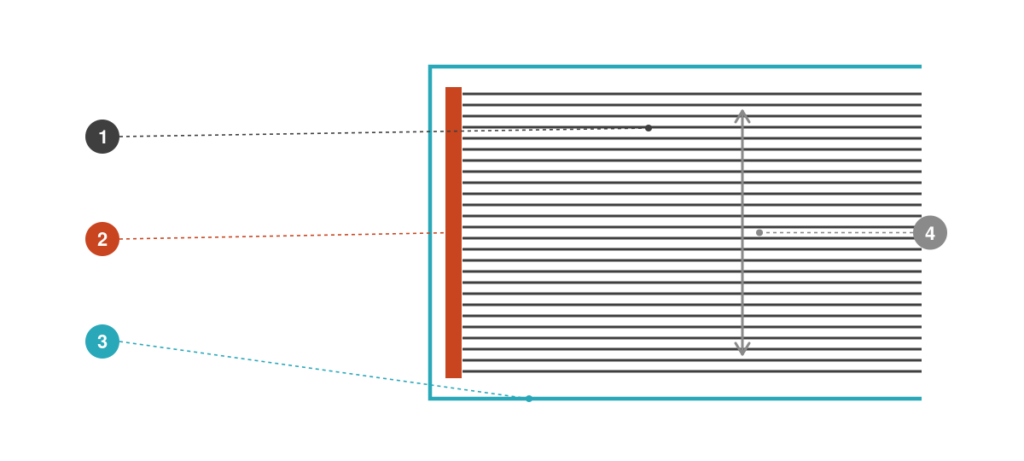
1 Single leaves — the folds are milled away, so each page stands on the glue on its own. Nothing is caught by a fold any more.
2 Glue layer — PUR or hotmelt, applied to the roughened spine and often notched to give it a mechanical key.
3 Wrapped cover — drawn on in one piece and creased at both spine folds so it opens without cracking.
4 Grain direction — the fibres must run parallel to the spine. Get this wrong and the book is stiff, the pages will not turn cleanly and the spine cracks in use. It is decided at imposition, long before binding.
PUR or hotmelt — the decision that actually matters
PUR
Polyurethane. It cures with moisture rather than simply cooling, and the result is a bond roughly a third stronger in page-pull testing than hotmelt, far more flexible, and stable from well below freezing to temperatures a parcel shelf in July will never reach.
It grips coated and laminated stock that hotmelt lets go of, and it lets the book open much closer to flat. The cost is money and time: PUR needs curing before the book can be trimmed and packed, so it adds a day.
Ask for PUR when the book has coated or heavy paper, a long life, images running across the gutter, or will be shipped and stored through real temperatures.
Hotmelt
The conventional, cheaper adhesive. It sets in minutes, which keeps the schedule short, and on uncoated text paper in a book that will be read and shelved it is perfectly adequate — novels, manuals, programmes, seasonal catalogues.
Its limits are real and physical: it goes brittle in the cold and softens in heat, and on coated or heavy stock the pages eventually release. A book left in a car in summer is the standard example, and it is not a hypothetical one.
What decides whether it will work
- Spine thickness. Below about 3 mm there is not enough edge for the glue to hold — roughly 28 pages on 80 gsm. Below that, saddle stitching is the honest answer. Above about 50 mm the block becomes unwieldy.
- Readable spine text needs roughly 6 mm of spine. Thinner than that and the title will not sit reliably between the creases.
- Grain direction along the spine — non-negotiable, and the single most common cause of a stiff, badly opening book.
- Coated or laminated stock — specify PUR, or accept that pages may release.
- Images across the gutter — perfect binding always loses a few millimetres into the spine. With PUR it loses fewer.
Perfect bound or thread sewn?
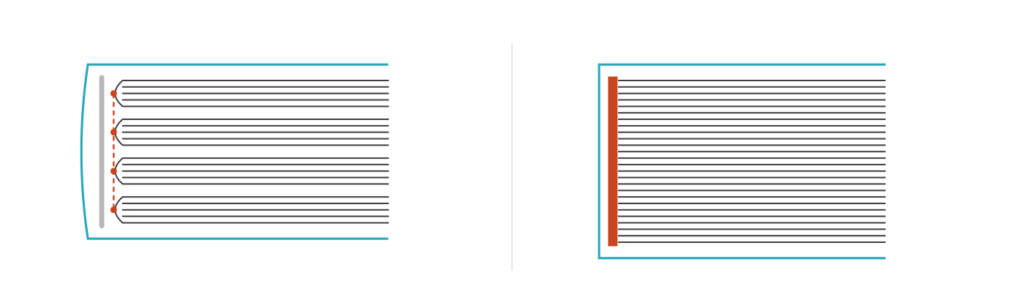
The same book block, held together two different ways. This is the decision most people are actually making — and it changes cost, durability and how the book opens.
| Perfect bound | Thread sewn | |
|---|---|---|
| Held by | Glue on a milled spine | Thread through every fold |
| Opens | Well with PUR, less so with hotmelt | Flat, without being pressed |
| Lasts | Years of normal use | Decades of repeated use |
| Extent | From about 32 pages to a 50 mm spine | From about 64 pages upwards |
| Coated and heavy paper | Needs PUR | No difficulty |
| Costs | Less — fewer operations | More — an extra operation |
| Suits | Novels, catalogues, manuals, reports | Reference, art, cookbooks, children’s books |
If your book is a reference work, an art book or anything that has to survive years of handling, read the other side of this comparison: thread sewn binding.
Selected productions
Four glued jobs, with the binding line taken from the real specification.

Nola catalogue
PUR binding, packed in reinforced boxes. A product catalogue built to survive the road.

Artworks catalogue
Glued softcover for an exhibition catalogue where the images carry the book.

The Turtles’ Big Adventure
Glued, perfect bound, 2.5 mm spine. A thin children’s title where sewing would have added cost without benefit.

Ireland Way Guide
Glued, 240 pages plus cover, French flaps 10 cm printed one side. A guidebook carried in a rucksack.
More in recent productions. Or go to the service page you need: book printing · catalogue printing · notebooks and planners · photo and art books.
Cost, schedule and a quote
Perfect binding is the least expensive way to bind a book of any real extent, and the fastest. PUR costs a little more than hotmelt and adds curing time — on most jobs it is money well spent.
We do not publish a price list, because every specification is quoted as a whole. Send us format, extent, paper and quantity — or just describe the book — and you will have a detailed quotation, usually within one business day.
Not sure what to specify? The book specification guide walks through format, paper and binding, and the file preparation guide covers bleed, colour and export.